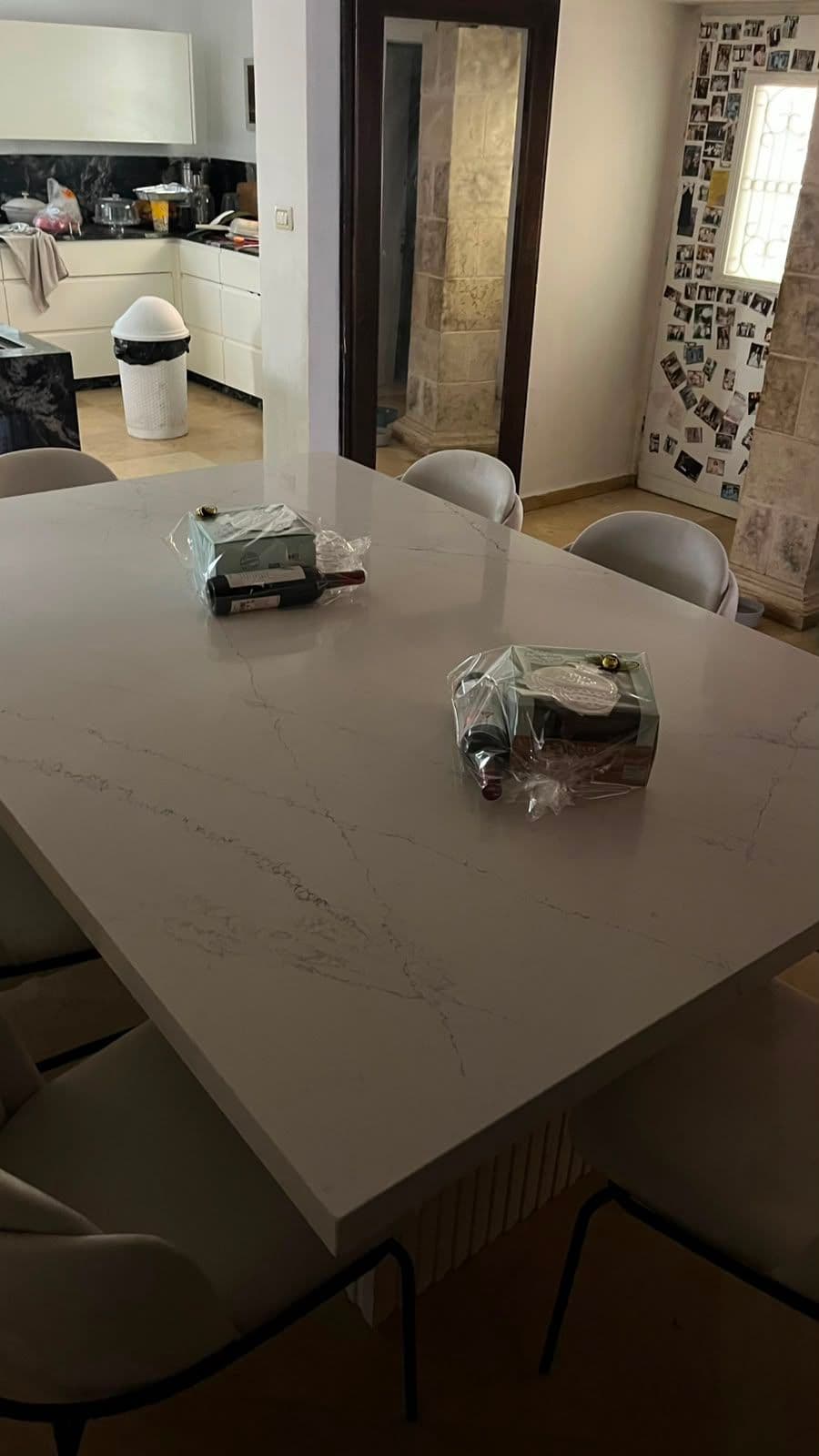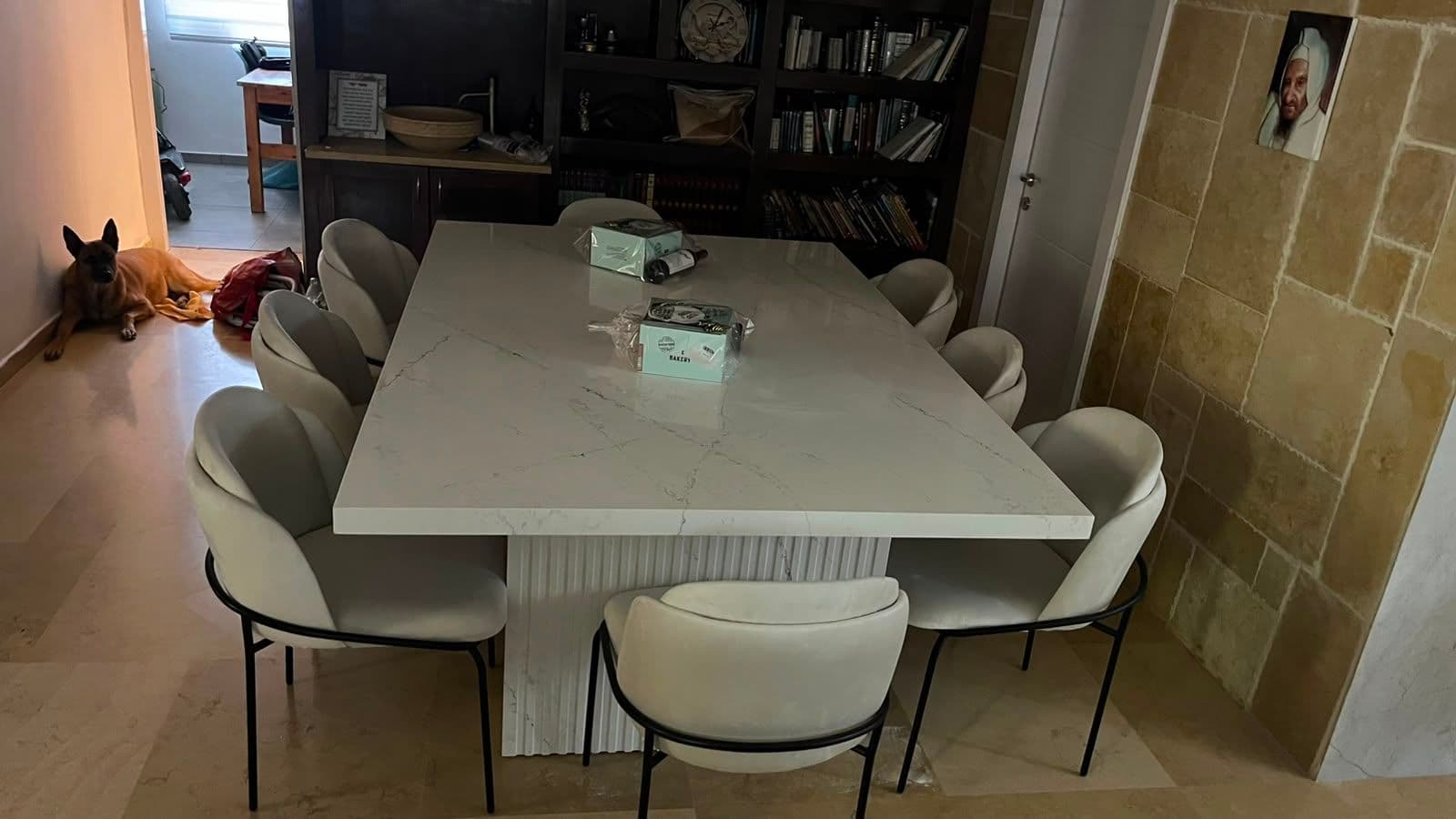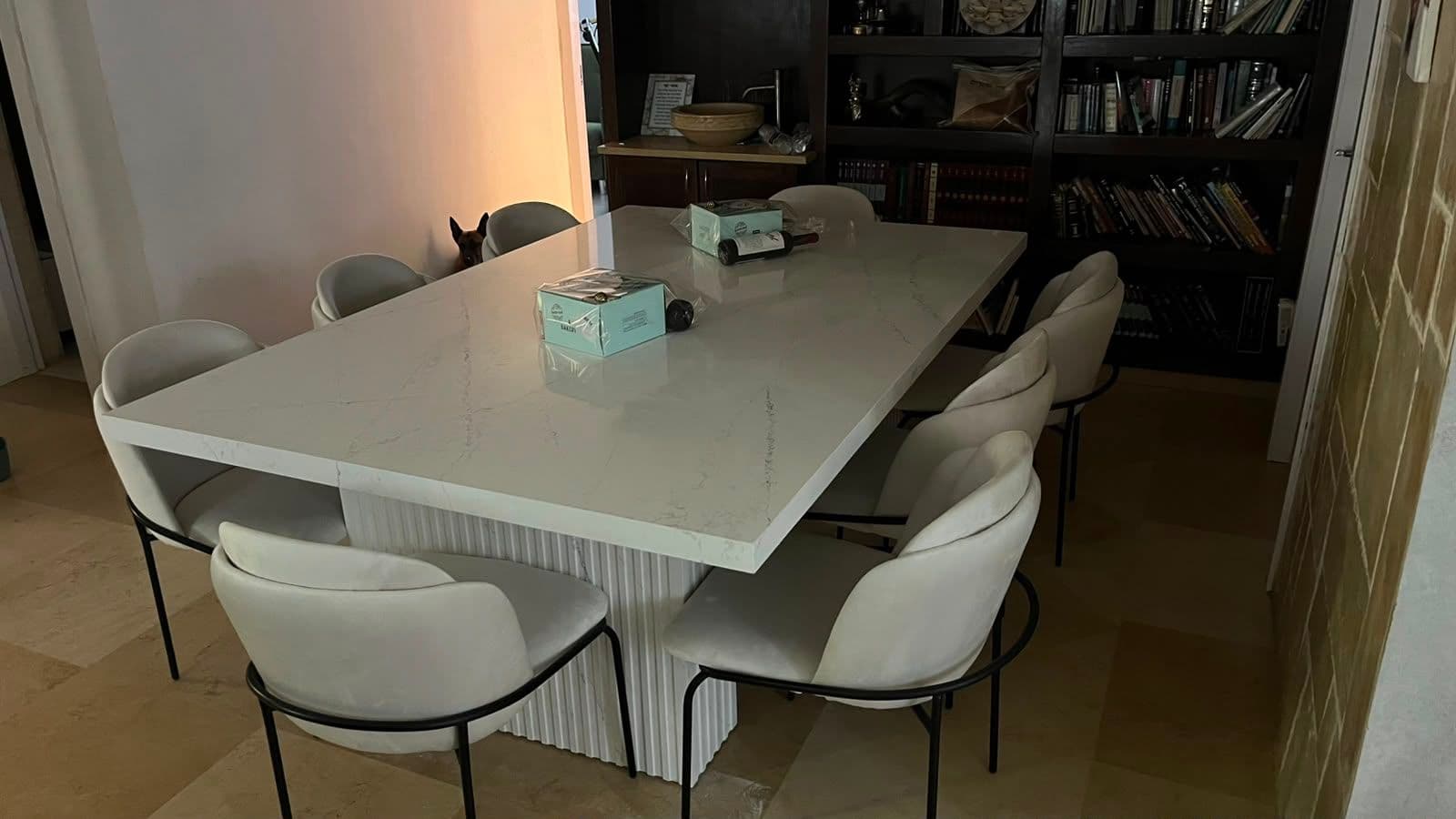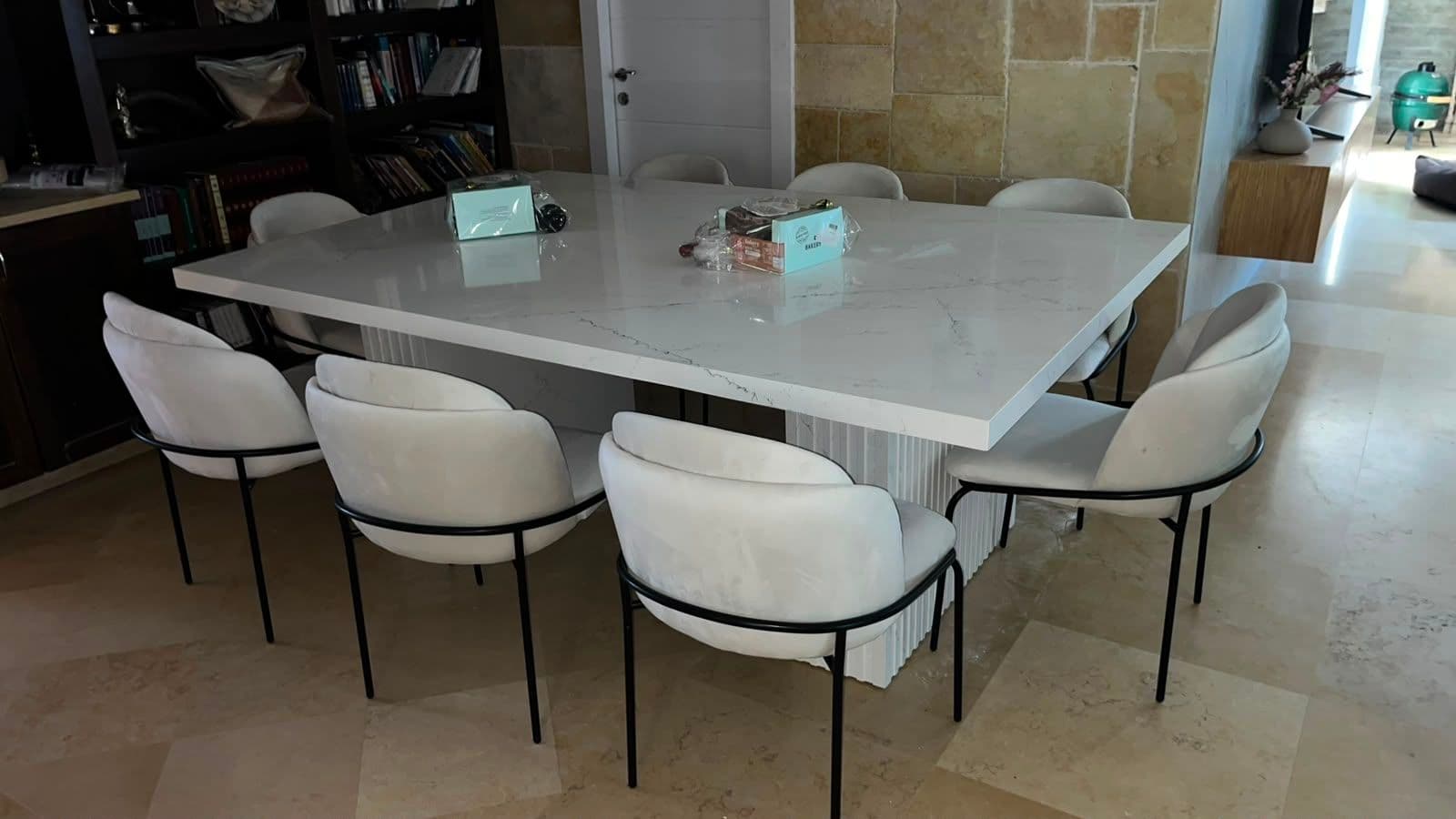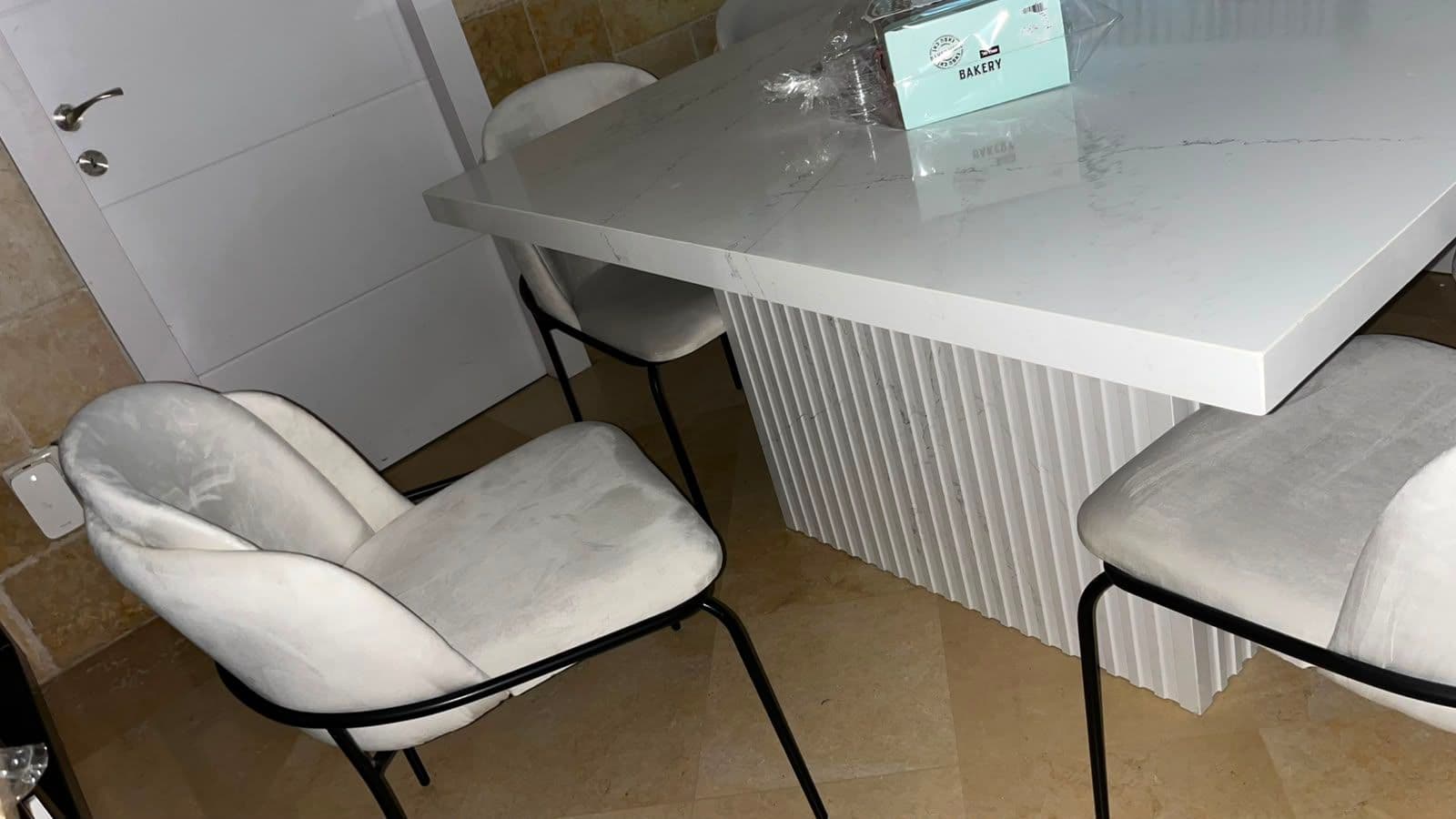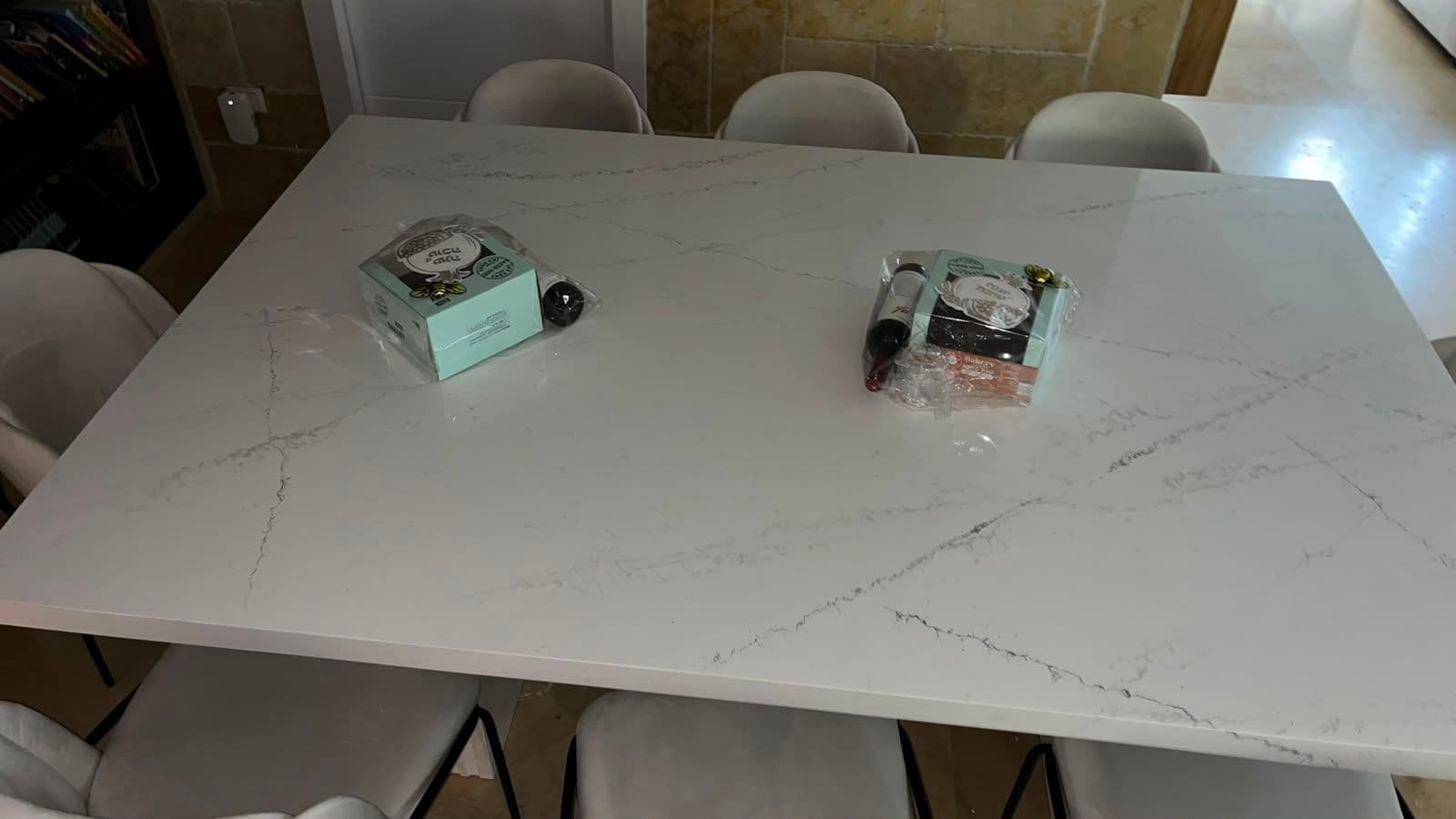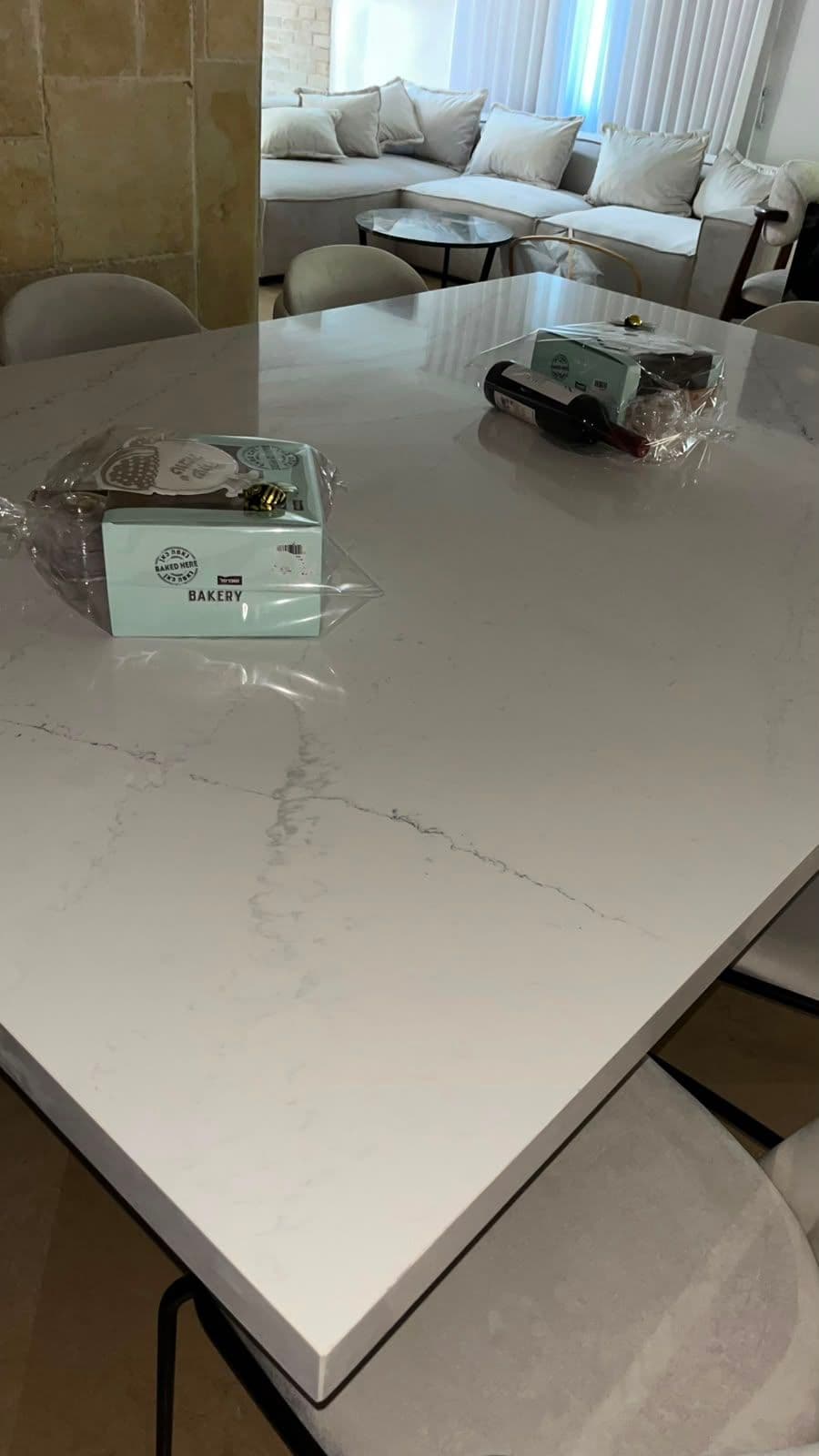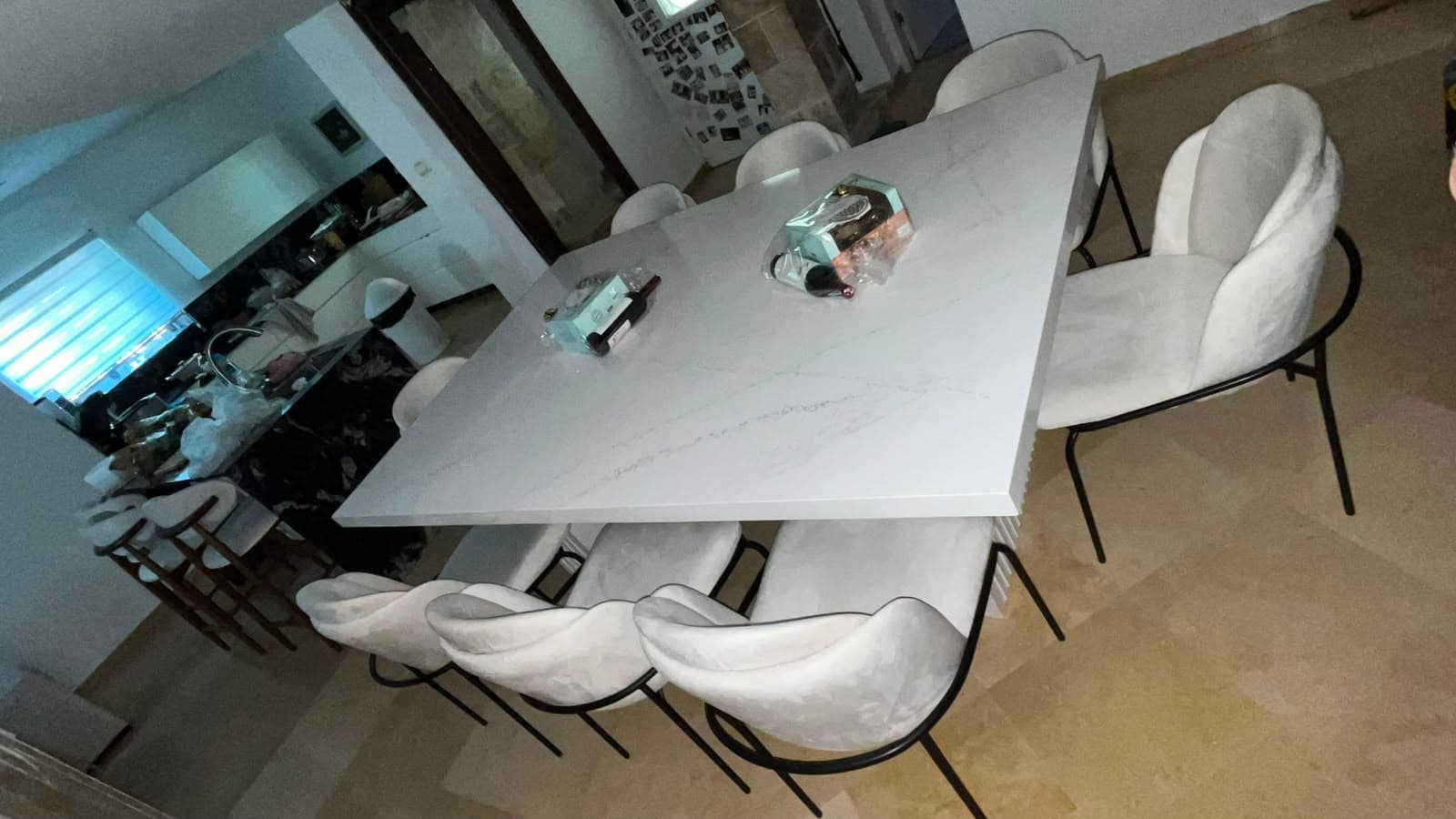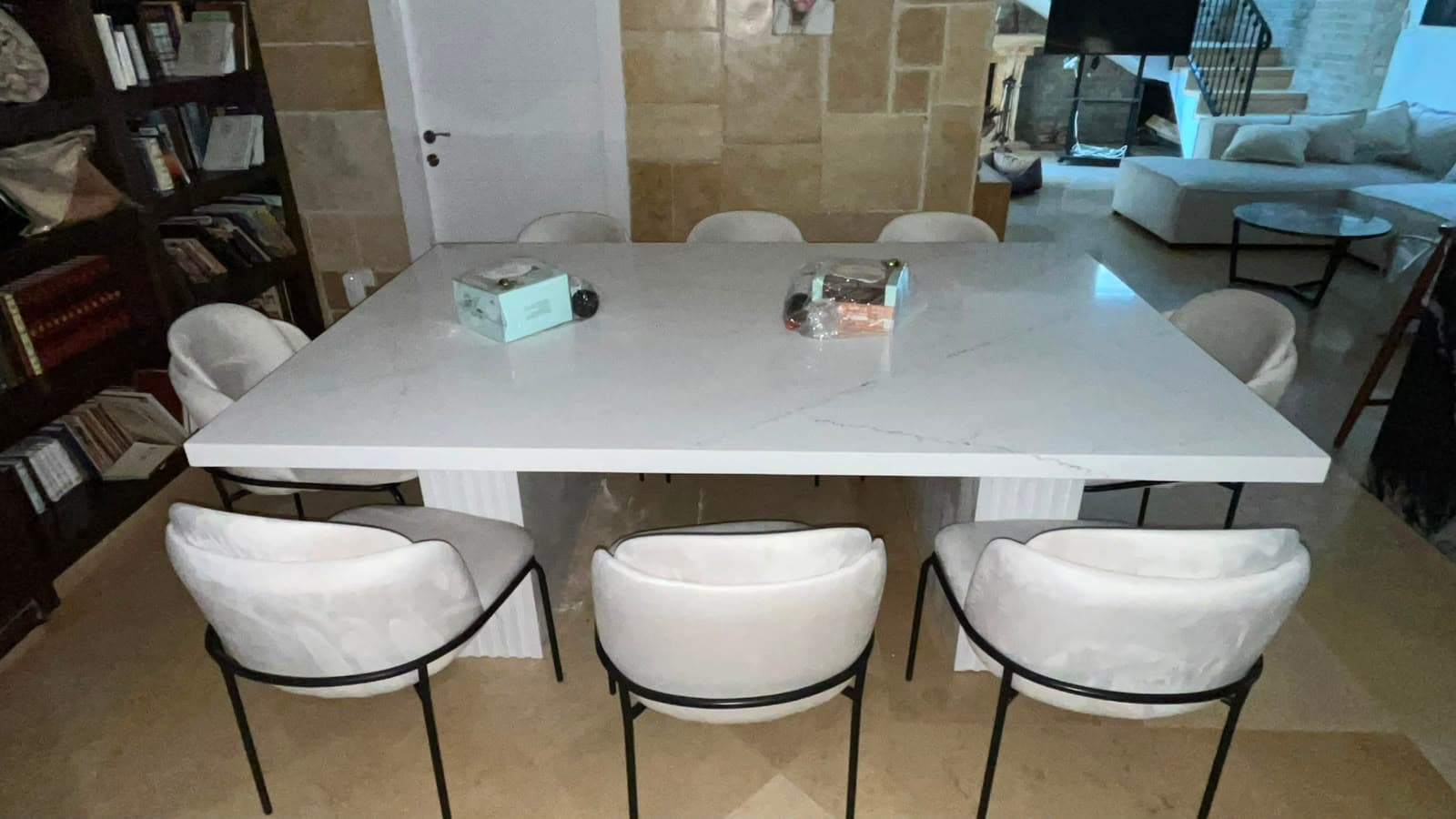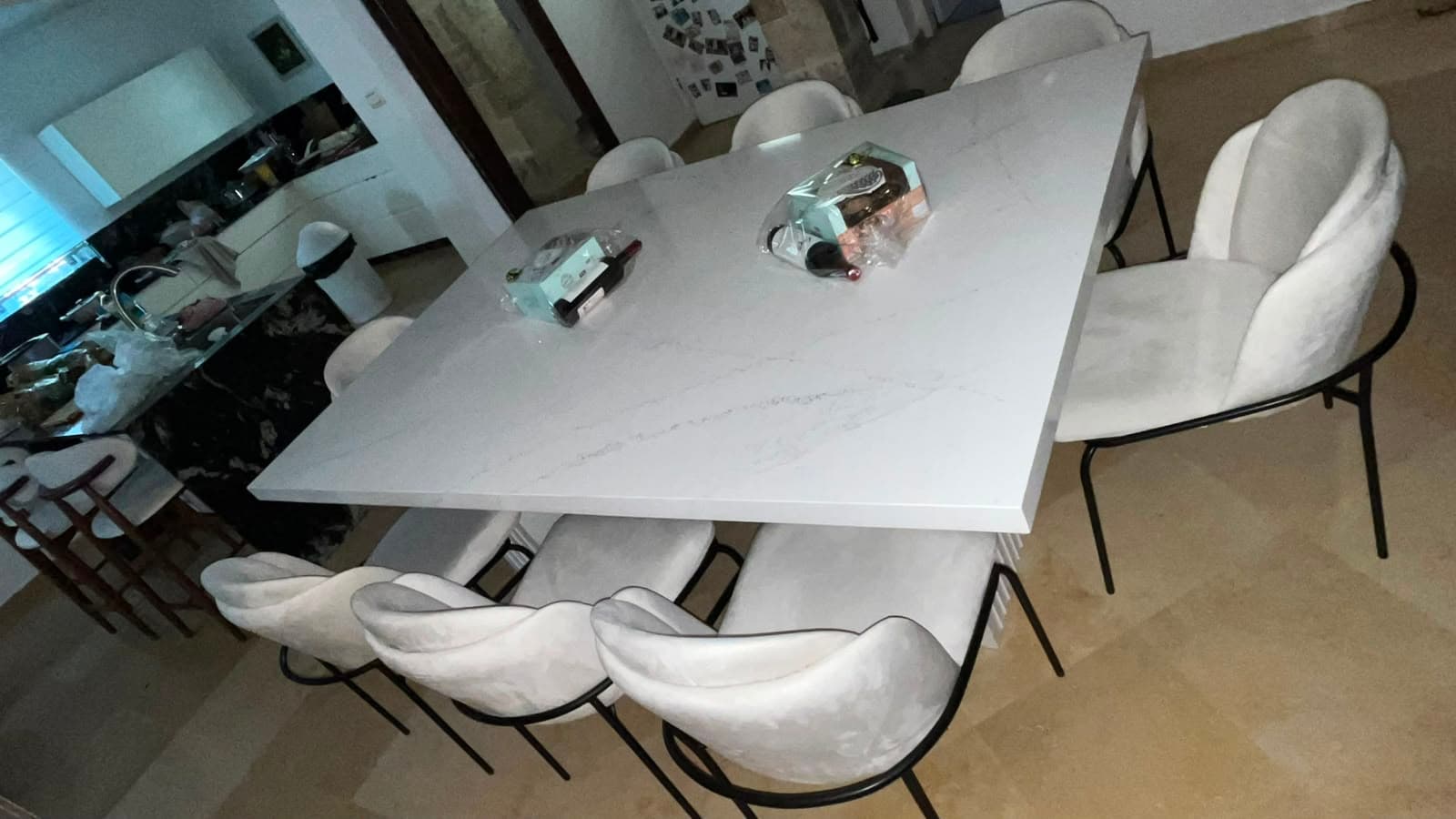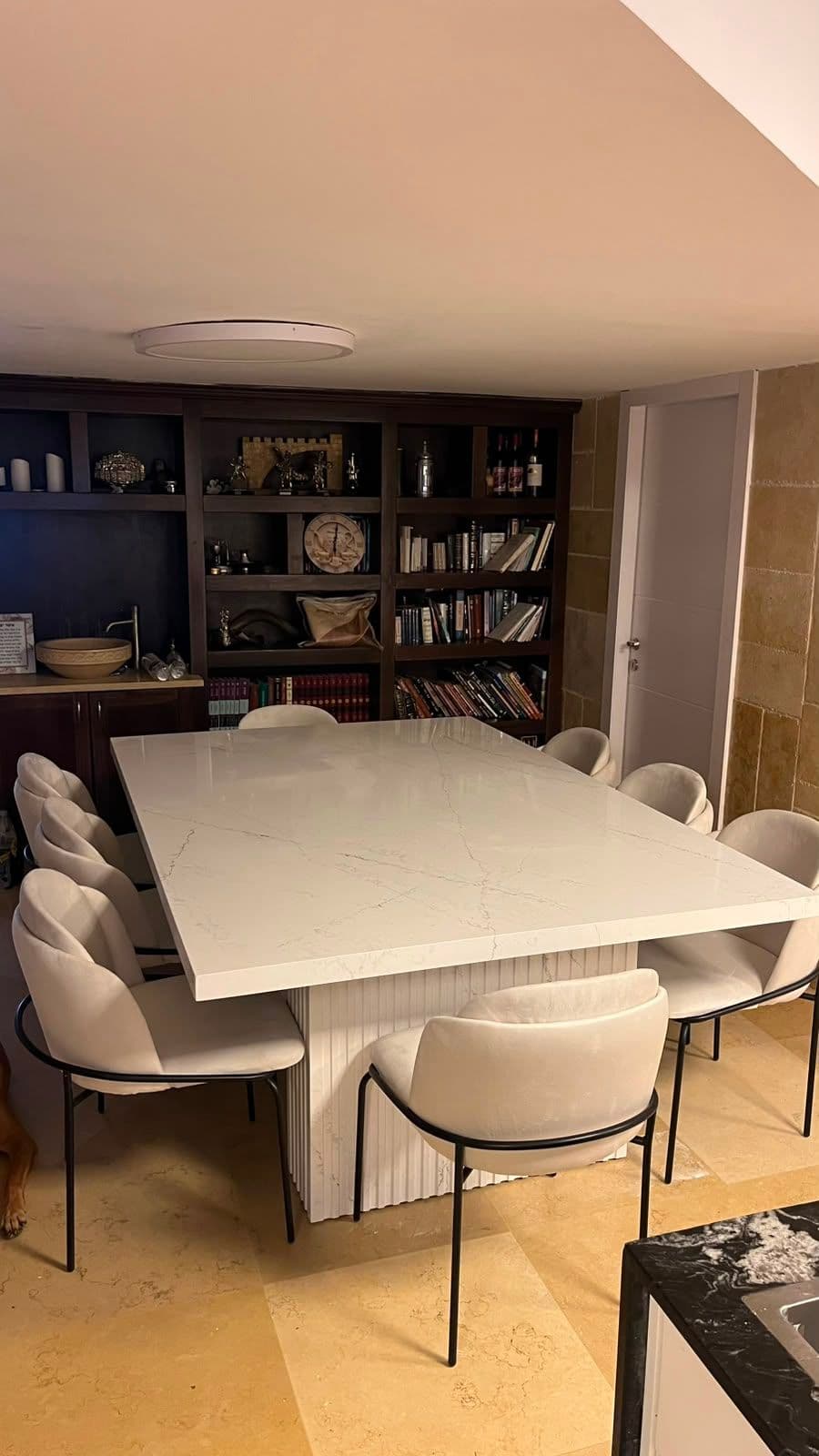
A private client ordered a single, monumental dining table: 240×140cm that looks as though it was cut from a solid block of stone, yet is built from a Silestone Ethereal Noctis quartz slab only 1.2cm thick, using a mitred edge that doubles its apparent thickness. The table stands on two sculpted, fluted legs that hide tiny casters inside — and still comfortably seats up to ten. Here is the full story: the architectural typology, the hidden engineering, and what's worth knowing about engineered quartz in 2026.
Not Just a Table — A Piece of Stone That Reorganises the Room
Some furniture fills a room; some reorganises it. The table in these photographs belongs to the second category: a single quartz surface measuring 2.4 by 1.4 metres, standing on two sculpted legs and comfortably seating eight to ten people around a Shabbat table or a family holiday meal. This was a fully custom commission from a private client, carried out by the Makor HaShayish team from start to finish — choosing the slab, fabricating it with precision, and installing it on site. It isn't just a place to sit; it's a statement about what an engineered material can do when it's treated like sculptural stone.
What makes this table special isn't only its scale. It's the combination of four things rarely found together: a jumbo, polished-finish quartz slab from the international Silestone brand, two sculpted, fluted legs that read like monolithic stone carvings, a thick, imposing edge that hides a clever constructive trick, and a hidden engineering detail that turns a genuinely heavy piece of stone into a table that moves almost by itself. This article unpacks each of those four elements in turn.
Between the Classical Trestle and Contemporary Minimalism: Two Legs That Move Like a Feather
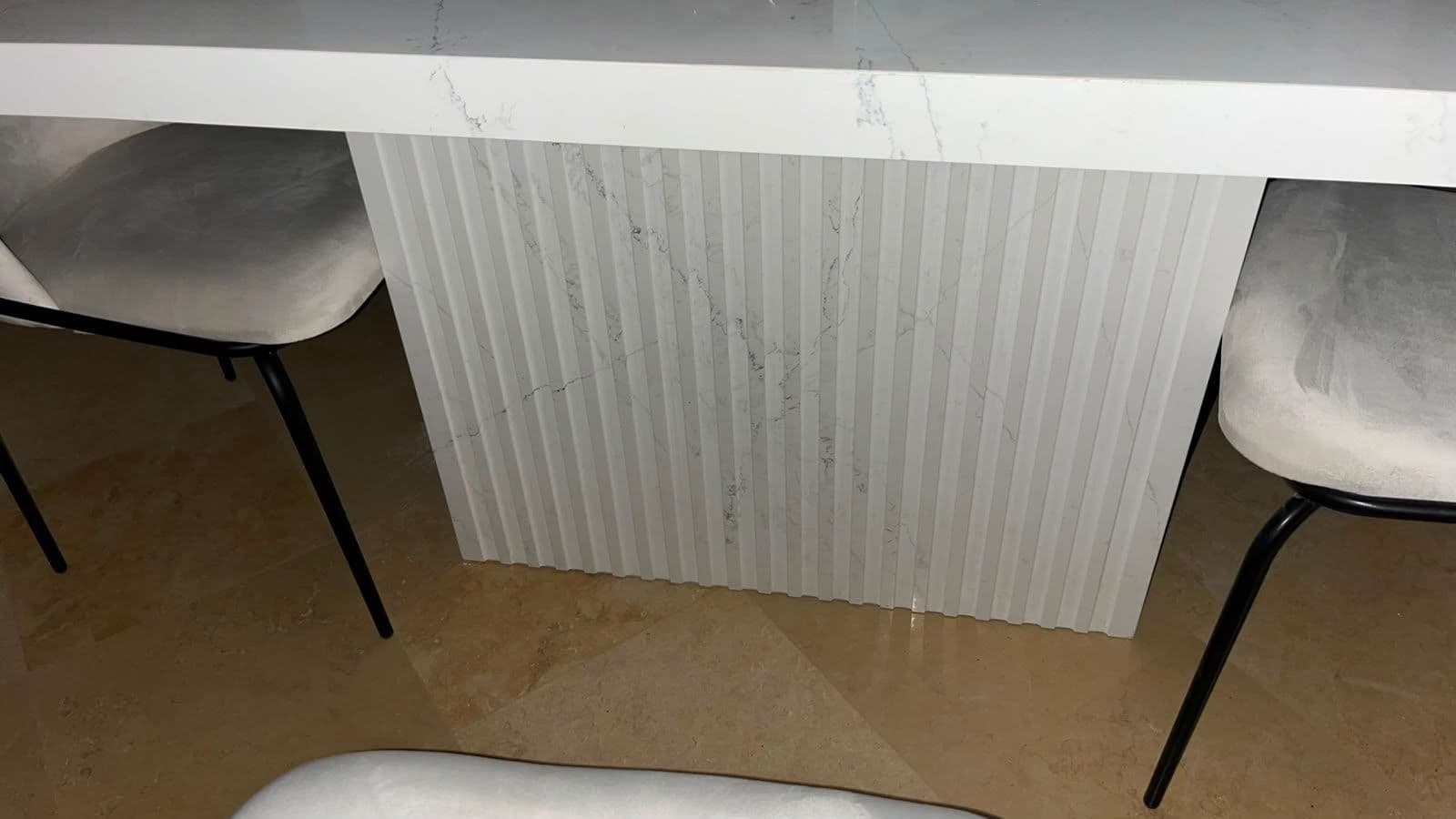
The table stands on two vertical legs rather than four ordinary ones — a decision that places it in the lineage of the trestle table, a typology tracing back to the refectory tables of medieval monasteries, where mass concentrates at two points of support and frees the rest of the perimeter for open, comfortable seating along both long sides. The interpretation here, though, is thoroughly neo-modern: the legs aren't solid columns but flat, vertically fluted stone panels, clad in the same quartz as the surface above, importing into the dining space a vocabulary borrowed from classical façade architecture — fluted columns, translated into furniture scale. The grooves, repeated along each leg, play with shadow and light as the day changes.
And here is the detail that surprises guests most once they hear about it: hidden inside each of the table's two fluted legs are a set of small, high-quality casters, almost invisible to the eye. The result is a striking, deliberate contrast — a block of stone weighing several hundred kilograms that looks as though it has been rooted to the floor forever, yet in practice needs no more than a single gentle push to glide smoothly across the room: clearing space for a large gathering, sliding the table toward the window in summer, or simply rearranging the seating in an instant. This is exactly the kind of engineering detail that separates high-end stone furniture from an ordinary piece: not just how it looks standing still, but how it behaves once you actually live with it.
Anatomy of a Construction: How 1.2cm Becomes Five
A standard Silestone slab measures roughly 325×159cm. The slab this table was cut from — SLAB POL ETHER.NOCTIS JUM, measuring 322×159cm — is a Jumbo format, Silestone's oversized version, which allows the entire tabletop to be cut almost as a single continuous piece, with the vein pattern running unbroken from edge to edge and no unnecessary seams. That is why the surface in the photographs reads as one continuous unit: because it genuinely is.
But the Jumbo format has a limit: a standard quartz slab is fabricated at only 1.2cm thick — a gauge that cannot visually carry a 2.40 × 1.40m tabletop without reading as flimsy. The solution is a mitred edge: two strips cut from the same slab, to preserve unbroken vein continuity, are joined at a 45-degree angle around the entire perimeter. The effect is purely visual — an edge that reads as a solid four-to-five-centimetre mass — while the actual weight stays close to that of a much thinner panel. It's a construction that lies honestly: the illusion is declared, not hidden, and that's exactly what makes it so impressive to explain to guests around the table.
Materiality: Reading the Veining Across Engineered Quartz
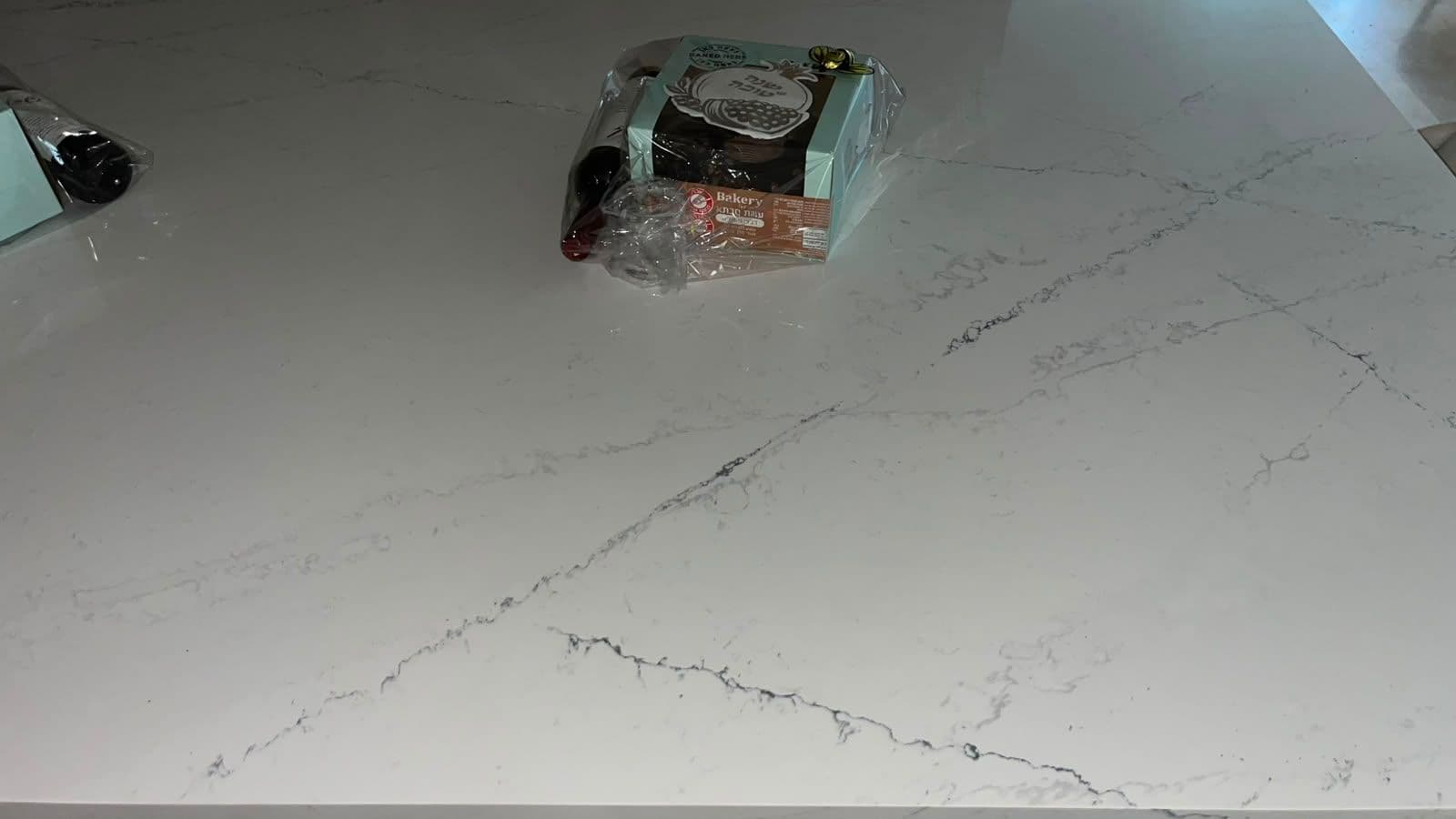
Despite the everyday label "marble," this is Ethereal Noctis — a slab from Silestone's Ethereal collection, an engineered quartz material by Cosentino, not a natural stone. The tone builds a cool white ground crossed by branching grey veins of varying width — from a thin line nearly swallowed by the background to a main vein that cuts the slab on the diagonal, in a pattern that consciously echoes classical Italian Carrara. In the polished finish, the veins don't just read, they move: as the light's angle shifts through the day, each vein becomes its own reflective plane, so the surface never looks quite the same twice.
Quartz, unlike natural marble or granite, is an engineered material: roughly 90% natural quartz crystals, bound with resins and pigments under pressure and vacuum. The result is an almost entirely non-porous surface that resists red wine, olive oil, pomegranate juice, or a chocolate stain — exactly the kind of marks that land on a real family dining table. That's the material's double tactility: cold to the touch, yet rich and dynamic to the eye — and it's why quartz has become the material of choice in recent years for dining surfaces that actually get used, not just admired.
Technologically, Silestone has quietly transformed in recent years: every colour in the range is now produced with HybriQ+ technology, which draws on recycled raw materials, renewable-energy and high-recycled-water manufacturing, and a dramatic cut in crystalline-silica content — some colours now sit below 10% crystalline silica, compared with far higher levels in earlier generations of engineered quartz. On top of that, the slab's built-in N-Boost technology delivers high resistance to liquids and staining from the moment it's installed, with no periodic sealing required — a real maintenance advantage for a surface that functions as the true centre of the home.
Why Quartz, Not Natural Marble, for an Everyday Dining Table
Natural marble is breathtaking, but it's also porous and acid-sensitive: a glass of red wine left too long, a slice of lemon, or even a splash of vinaigrette can leave a permanent mark within minutes. On a dining table that gets used almost every day, that's a real maintenance risk. Quartz solves the problem at the root: a non-porous surface, resistant to acids, scratches and impact, that needs no periodic sealing and stays beautiful for years even under the intensive use that comes with children, guests, and family meals. That's why more and more clients in Israel are now choosing quartz specifically for the large, central dining table in the home — not only for the kitchen.
How It Actually Works: From Order to Installation
A table like this begins with a consultation to understand the desired dimensions, the number of guests it needs to seat, and the preferred leg style — a single column, twin legs, or two fluted legs like the ones in this project. Next comes selecting a matching Jumbo slab from Silestone's colour range, followed by precision fabrication: cutting the top surface, finishing the edges with a mitred-edge technique, and carving the two fluted legs — all from the same slab, to preserve a perfectly continuous look. On-site installation is carried out by a professional team, including fitting the hidden caster mechanism inside each leg, with a final levelling and stability check before the work is handed over.
Dreaming of a Table Like This in Your Own Home?
The dining table is, for most homes, the single most central piece of furniture — the place where Friday nights, birthdays and holiday meals happen. If you'd like a table just as unique, fully tailored to the dimensions of your own dining corner and the number of guests you host, the Makor HaShayish team would love to guide you from the first idea through to installation: choosing the right quartz tone from our range, shaping the legs, and even building in smart engineering touches like a hidden caster mechanism. Get in touch with us today through the site, and let's start planning the dining table your family will gather around for years to come.